Auxiliary vs Lexical verbs

Perhaps, when you look at these verbs, you started to feel panic because you do not know how and when to use them. Children, do not worry. Actually, these auxiliary verbs can be categorized into five classes :
1. Passive be - This is used to form passive construction, eg

2. Progressive be - As the name suggest, the progressive expresses action in progress :
3. Perfective have - The perfective auxiliary expresses an action accomplished in the past but
retaining current relevance

4. Modals - Can/could/ may/ might/ shall/ should/ will/ would/ must
- Modals expresses permission, ability, obligation or prediction

5. Dummy do - This subclass contains only the verb do.
- It is used to form questions.

- to form negative statements

- and in giving orders

- Finally, dummies do can be used for emphasis :

An important difference between auxiliary verb and lexical verb is that auxiliaries never occur alone in a sentence. For instance, we cannot remove the lexical verb from a sentence, leaving only the auxiliaries.

Auxiliaries always occur with a lexical verb. On the other hand, lexicalverbs can occur without an auxiliaries

So now, you are aware of the difference between lexical and auxiliary verb. To enhance your understanding, let us do this exercise :
In the exercise below, you have to identify the bold word whether it is "AUXILIARY" or "LEXICAL" verbs. 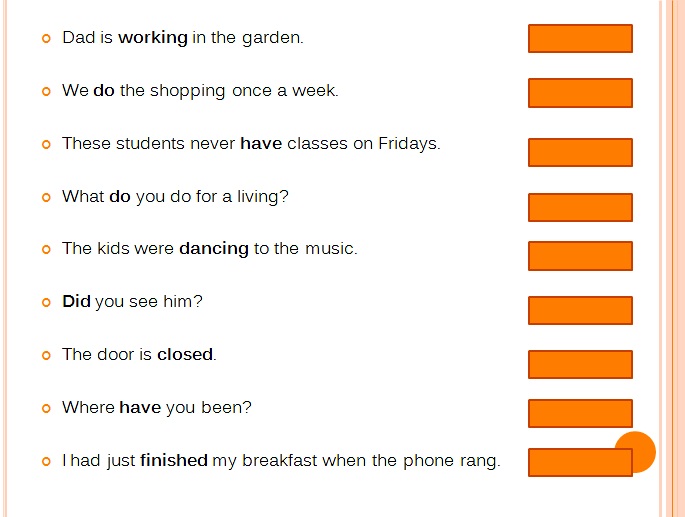 |
SOURCE : http://www.ego4u.com
