Dynamic and Static verbs
Dynamic verbs
- "Dynamic" is an adjective which means something is moving or changing.
- In English grammar, a 'dynamic verb' means that the verb describes an action rather than a state.
- Dynamic verbs are sometimes known as 'action verbs'.
 |  |
Stative verbs
- "Stative" is an adjective which describes something as having a state, or existing.
- In English grammar a stative verbs means that the verb describes a state rather than an action.
- Stative verbs are sometimes known as "state verbs".
 |  |
So now you know the meaning of the terms, let us look at some examples!
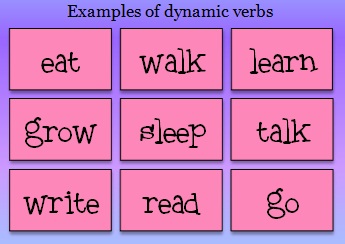
First, here is a list of some Dynamic verbs. You can see that they are all used to describe an action, change or
process. Most of them are used to describe an activity which has a start and an end.
|
Here is a list of some of the Stative verbs. Some of these describe relationships between things or people and some describe emotions or states of mind.
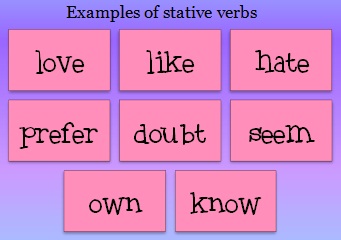
Here are some examples, showing that these words cannot be used in the progressive form. Correct: "I like chocolate, but I prefer cake." Incorrect: "I'm liking chocolate but I'm preferring cake." Correct: "I don't understand you when you speak quickly." Incorrect: "I'm not understanding you when you speak quickly." There are also some verbs that can be either dynamic or stative, depending on their meaning and context in the sentence. I'm sure you know by now that there are many words in English that can have more than one meaning!
|
There are also some verbs that can either dynamic or static, depending on their meaning and context in the sentence.
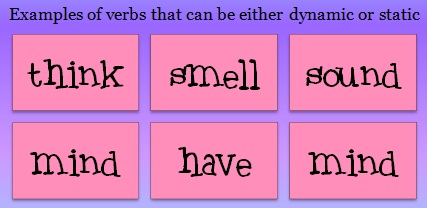
Let's look at some examples of how these verbs are used differently.
Example sentences:
|
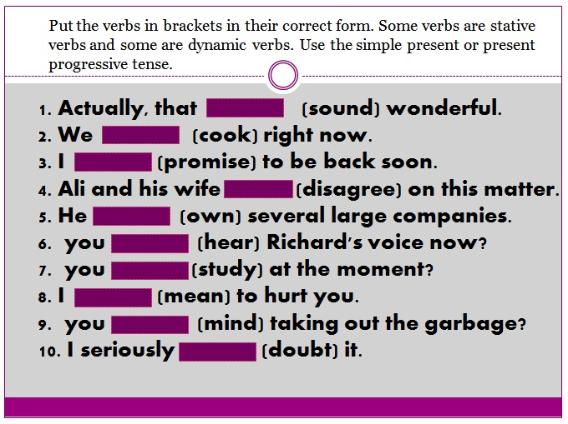
All this may seem complicated, but if you read and listen to as much as English as you can, you will soon to know which verbs sound right in the progressive. if you keep the basic idea of dynamic verbs vs static verbs in the back of your mind, it will help you greatly. Now, let's practice !